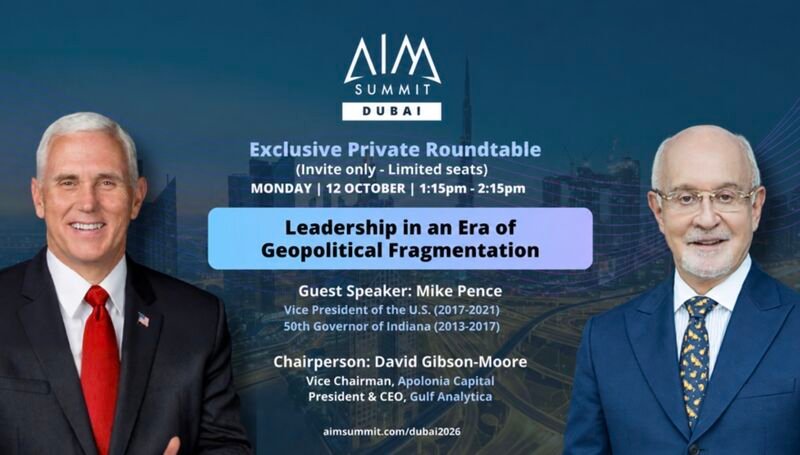
Just two weeks before the 2024 US presidential election, I had the privilege of moderating a panel at the AIM Summit in Dubai. The topic was “The US Election: Geopolitics and Foreign Policy”. Among the distinguished panellists was Kevin McCarthy, the 55th Speaker of the US House of Representatives. Looking back today, both the timing and the subject matter feel even more significant than they did then.
It was particularly valuable to hear such an authoritative voice address one of the defining geopolitical questions of our time: how should the United States respond to China’s emergence as a major economic and strategic power while managing the broader transition from a unipolar to an increasingly multipolar world?
The discussion also brought to mind a conversation I had with Professor Stephen Roach in 2022, which focused largely on Thucydides’ Trap. Popularised by Harvard political scientist Graham Allison, the term describes the danger that arises when an emerging power challenges an established one. This creates tensions that may ultimately lead to conflict even when neither side necessarily seeks it.
It has been fascinating to revisit this exchange in the light of everything that has followed. How the United States accommodates a more widely distributed global balance of power will shape not only US–China relations but the future international order.
I would be most interested to hear your comments on the present situation and the developments since our discussion.