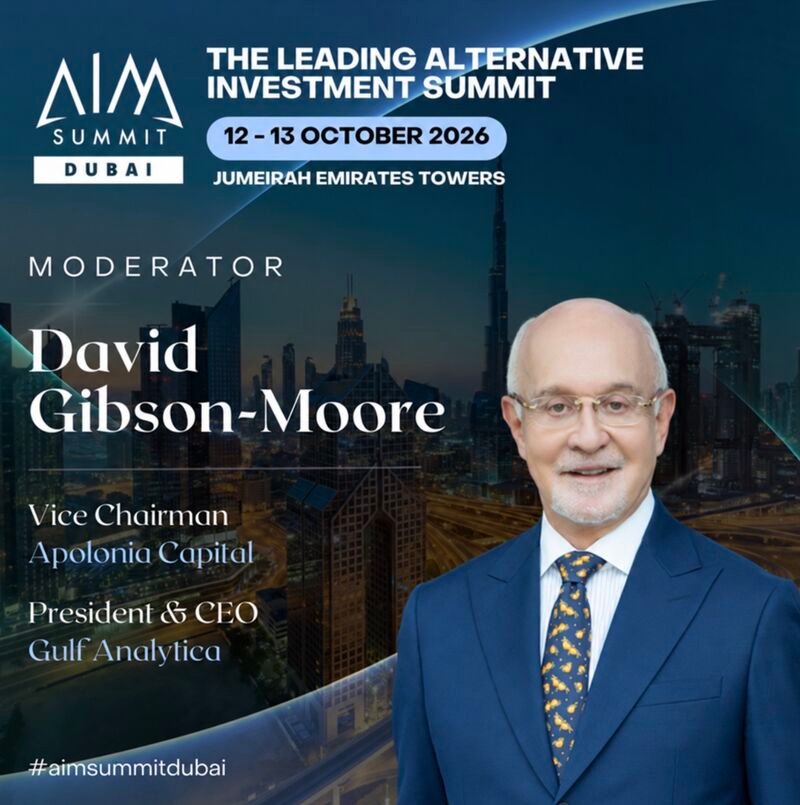
It was a privilege to moderate the opening morning panel at the recent AIM Summit in Dubai on the theme Global Macro Under Pressure: Inflation, Policy and Fragile Sovereigns.
Our distinguished panellists Carla Slim, Chief Economist for the Middle East and Pakistan at Standard Chartered, Ambassador Bruce Heyman, former U.S. Ambassador to Canada and CEO of Power Sustainable and Zemedeneh Negatu, Global Chairman of Fairfax Africa Fund, provided a thought-provoking blend of analytical insight and practical perspective.
It is certainly fair to say that the world economy is navigating some of the most intricate crossroads in decades: continuing inflation in some regions, debt pressures abounding and a growing sense that the old economic playbook no longer fits the times.
To set the context, our conversation first explored how inflation patterns are diverging sharply across major economies. While the Eurozone and parts of Asia are approaching their targets, the United States remains a majoroutlier facing “sticky” inflation and a narrow path for policy easing. Yet employment remains strong which is an equilibrium that feels somewhat precarious.
We then turned to the issue of sovereign debt which is now projected, according to a recent IMF report, to surpass 100 per cent of global GDP by 2029. This is a level not seen since the immediate post-World War II era. We concluded that the question is not simply whether rollover risk is increasing but rather where the pressure points will surface first.
Despite these challenges, several bright spots emerged. India, ASEAN and the GCC economies are demonstrating resilience through reform momentum and, in the latter case, strategic investment in non-oil growth. In Africa, where debt servicing costs are rising, there remain powerful demographic and technological opportunities if reforms can be sustained.
We also explored the deeper structural shifts shaping the next decade: protectionism replacing globalisation, the weaponisation of trade and currency networks and the growing push for regional financial systems. Amid this fragmentation, Dubai’s position as a hub linking the GCC, South Asia and Africa seems more relevant than ever which was a sentiment which especially resonated with our audience.
Our discussion closed with a reflection that the coming years will deliver both heightened risks and significant opportunities. Navigating them will demand agility and, above all, a willingness to adapt to a world where global macro stability can no longer be taken for granted.
My thanks to our panellists for their candour and insight and to Standard Chartered for hosting a most engaging session at the AIM Summit 2025.
#aimsummit #macroeconomics #inflation #sovereigndebt #geopolitics #gcc